
Common questions
Which Vehicle Lift Is Right for My Workshop? Two-Post, Four-Post or Scissor?
Published , updated
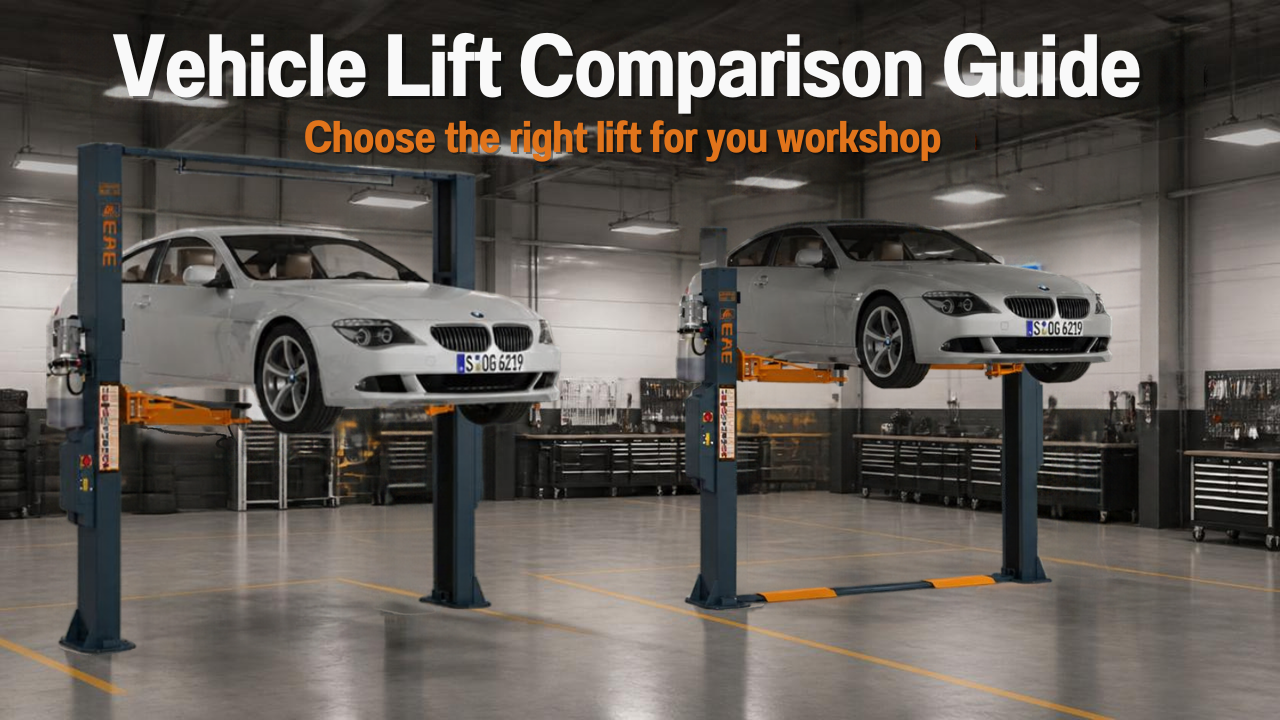
Two-post, four-post or high-rise scissor? How to choose the right vehicle lift for the work you do, the vehicles you handle and the space you have.
The right lift depends on the work you do, the vehicles you work on and the space you have. It isn't simply "buy a two-post" or "buy the biggest lift you can afford."
The short answer
- Two-post: the best value and the most versatile choice for general mechanical work, with the wheels free and the underbody open.
- High-rise scissor: wheel-free access with no columns beside the vehicle and no overhead beam. A genuine alternative to a two-post. It costs more, but it is much nicer to use and takes up less space.
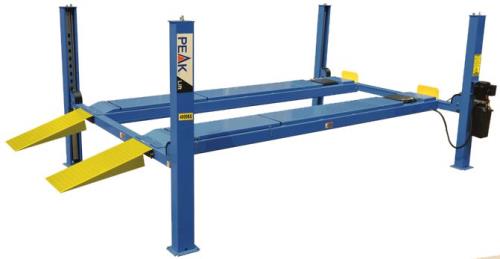
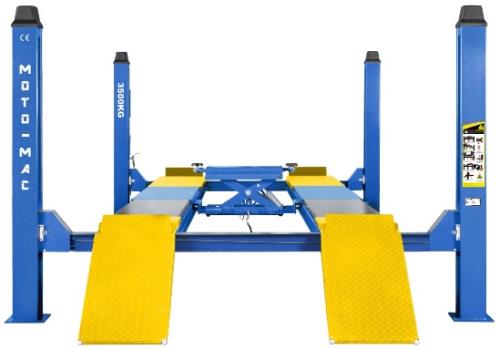
- Four-post: the right choice for wheel alignment, vehicle storage, longer vehicles, and work where the suspension must stay in its natural position, such as exhaust fitting.
Before you decide, check your ceiling height, your floor, the vehicles you lift (and what is on their roofs) and whether you need the wheels free.
Start with the work you do
What do you spend most of your day doing?
- General mechanical repairs: a two-post lift is usually the best value, with excellent access underneath and the wheels free.
- Tyres, brakes and suspension: a two-post or a high-rise scissor lift gives you the wheel-free access you need.
- Servicing, inspections and oil changes: a two-post or a high-rise scissor lift both work well.
- Wheel alignment: a four-post alignment lift is the better choice.
- Exhaust work: a four-post lift keeps the vehicle on its wheels, so the suspension stays in its normal loaded position.
- Vehicle storage: a four-post lift is the obvious choice.
Two-post lifts: best value and maximum access
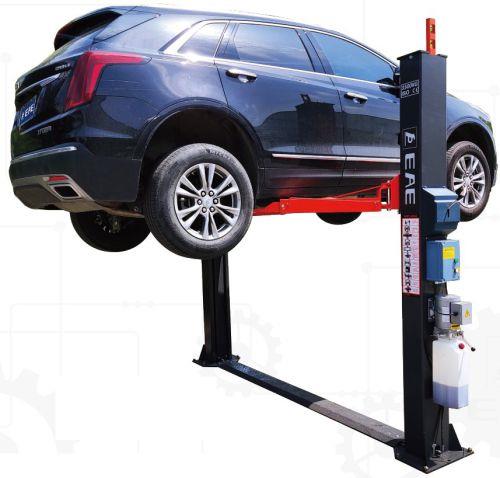
A two-post lift raises the vehicle by its chassis lifting points, which leaves the wheels completely free. That gives you excellent access to the wheels, brakes, suspension, steering, underbody, exhaust, transmission and engine. There are no runways beneath the vehicle, so transmission jacks, workshop trolleys and other equipment can go straight underneath it.
For brake, suspension, steering, engine and transmission work, tyre-related jobs and general servicing, that combination of price, versatility and access is difficult to beat. Check the capacity against the heaviest vehicle you will lift: our two-post lifts run from 3.5 ton to 6 ton. Browse all our two-post lifts.
Base-free or base-type?
One of the main decisions is between a base-free and a base-type two-post lift.
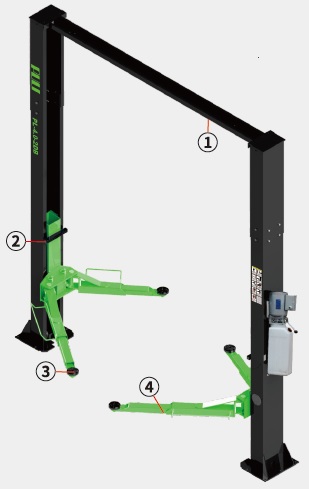
Base-free. An overhead beam connects the two columns and carries the hydraulic hose and synchronisation cables, so there is nothing on the floor between the columns. That makes it easy to move transmission jacks, workshop trolleys and small-caster equipment underneath the vehicle. The beam also holds an electrical safety limit stop: if the vehicle reaches it while being raised, the lift stops automatically, which helps prevent the roof of the vehicle from being raised into the workshop roof. A base-free lift needs about 4 m of ceiling height. Examples are the EAE 4.2 ton base-free two-post lift and the MOTO-MAC 4 ton base-free two-post lift.
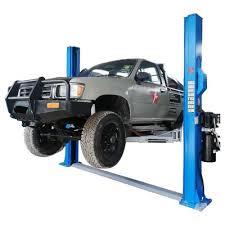
Base-type. A base-type lift has no overhead beam. Instead, a plate on the floor between the columns covers the hydraulic hose that connects the main cylinder to the auxiliary cylinder, and the cables that synchronise the height of the two carriages that lift the vehicle. Without the beam, it can be the better choice where ceiling height is restricted. It also suits workshops that work on high-roof vehicles or vehicles with roof racks and other roof-mounted accessories. Without the overhead beam and its electrical roof stop, the operator needs to watch closely how high the vehicle is raised, because a high-roof vehicle could touch the workshop ceiling. Examples are the EAE 4 ton base-type two-post lift and the MOTO-MAC 4 ton base-type two-post lift.
So don't only ask whether the lift will fit in your workshop. Ask:
What vehicles will I be lifting, and what is on top of those vehicles?
Concrete and ceiling for two-post lifts
Two-post lifts need an appropriate foundation. As a general HGE guideline, the concrete should be at least 200 mm thick and 25 MPa strength. Allow about 4 m of ceiling height for a base-free lift. Always check the installation requirements for the specific lift before installation.
High-rise scissor lifts: a genuine alternative to a two-post
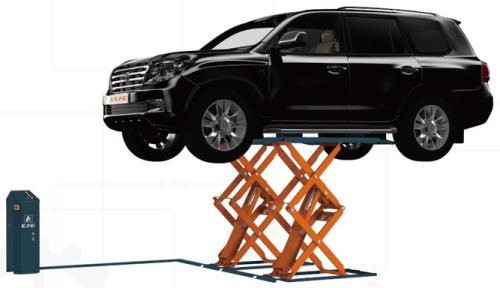
The scissor lifts discussed here are high-rise lifts that raise the vehicle to about 2 m with the wheels free. They are not the smaller scissor lifts used for quick tyre and brake work, which we list separately as low-level lifts.
Why choose a high-rise scissor lift?
- Wheel-free access to the suspension, underbody, tyres and brakes, and good access for general mechanical repairs
- About 2 m of lifting height
- No columns beside the vehicle and no overhead beam
- Easier vehicle positioning
- Good use of limited side space
- Nothing standing beside or above the vehicle when it is lowered
They are worth considering where side clearance, ceiling clearance or the layout of your workshop makes a conventional two-post less convenient. The thing to weigh against them is cost: a high-rise scissor lift costs noticeably more than a two-post of similar capacity. What you get for the extra money is a lift that is much nicer to use and takes up less space.
We have two models, the EAE 3.5 ton high-rise scissor lift and the EAE 4 ton high-rise scissor lift. They differ mainly in lifting capacity, and both are installed above ground. Browse our scissor lifts.
Four-post lifts: stability, alignment and storage
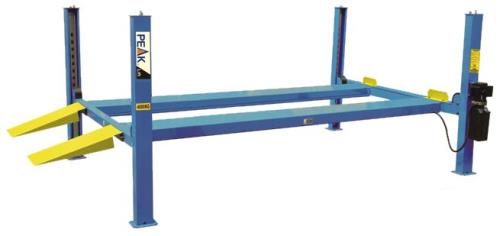
A four-post lift is a different proposition. The vehicle is driven onto runways and supported on its tyres, rather than lifted by its chassis. Four-posts are generally easier to drive onto and position than a two-post, and they suit:
- wheel alignment
- vehicle inspections and servicing
- exhaust work
- longer vehicles, and vehicles that are harder to balance on two-post arms
- vehicle storage, including in a home garage
- any job where the vehicle must stay in its natural suspension position
A four-post lift normally doesn't give wheel-free access by itself, because the wheels stay on the runways. For wheel-off work, an auxiliary (rolling) jack lifts the front or rear of the vehicle, so you can remove the wheels and work on brakes, tyres and suspension while keeping the advantages of the four-post. Some of our four-post lifts include an auxiliary jack and some don't, so check, and choose a jack that matches the lift's capacity. See our auxiliary jacks. Browse all our four-post lifts.
Why a four-post lift suits exhaust work
This advantage is easy to overlook. On the runways the vehicle stays supported by its wheels, so the suspension sits in its natural loaded position. An exhaust system has to be routed and fitted relative to the vehicle at its normal ride height, so for exhaust fabrication and installation a four-post lift is very useful.
Four-post lifts for wheel alignment
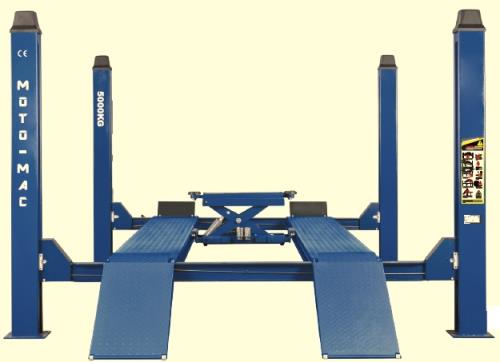
A four-post lift is the usual choice when wheel alignment is part of your work. But not every four-post lift is an alignment lift. The PEAK 4 ton four-post alignment lift and the MOTO-MAC 3.5 ton four-post alignment lift have recesses designed for alignment turntables. The turntables are not supplied as standard, and inserts fit into the recesses when you are not aligning. That means you can use the lift as a normal four-post now and add the alignment equipment when you need it, which suits a workshop that wants to grow into alignment without buying a complete setup at once. See our wheel aligners.
Four-post lifts for vehicle storage
A four-post lift isn't only a workshop tool. Many customers buy one to store vehicles in a home garage where floor space is limited. By lifting one vehicle, the space underneath can potentially hold another vehicle or your storage, subject to your ceiling height, the lift's specifications and safe clearances. That suits collector vehicles, second vehicles, workshop storage, home garages, businesses with limited parking and vehicles that are not used every day. Examples are the PEAK 4 ton four-post lift and the MOTO-MAC 5 ton four-post lift.
Concrete for four-post lifts
Four-post lifts generally don't need the same concrete thickness as a two-post. As a general HGE guideline, they can be installed on about 150 mm of concrete, subject to the specific lift and installation requirements. Always confirm the requirements for the model you are buying.
Two-post, high-rise scissor and four-post side by side
- General mechanical work: a two-post is the best fit, a high-rise scissor is close behind, and a four-post works well with an auxiliary jack.
- Cost: a two-post costs the least, a four-post costs more, and a high-rise scissor costs the most.
- Wheel-free access: a two-post and a high-rise scissor give it; a four-post gives it with an auxiliary jack.
- Wheel and brake work, suspension work: excellent on a two-post or a high-rise scissor, and possible on a four-post with an auxiliary jack.
- Underbody access: excellent on a two-post or a high-rise scissor, good on a four-post.
- Wheel alignment: a four-post alignment lift is the usual choice; on a two-post or scissor it depends on the model and equipment.
- Exhaust work at natural ride height: a four-post is best; a two-post and a scissor are good.
- Vehicle storage: a four-post is excellent; a two-post or scissor is not normally the first choice.
- Longer vehicles: a four-post is easiest; a two-post can be harder to balance.
- Space beside the vehicle: a high-rise scissor is best, with no columns; a four-post is good; a two-post has columns beside the vehicle.
- Overhead beam: only on base-free two-post lifts.
- High-roof vehicles: a base-type two-post is preferred; a scissor or four-post is also a good option.
Allow for your workshop space
Don't only measure the floor area. Consider:
- ceiling height and vehicle height
- roof racks and high-roof vehicles
- side clearance and the space around the columns
- where tools and jacks will be positioned
- how vehicles enter and leave the bay
- what the lift looks like when it is fully lowered
A lift that fits on paper might not be the right lift once your actual vehicles are in the workshop.
Don't choose a lift on price alone
A two-post lift generally offers the best value for a general mechanical workshop. A four-post costs more, but if you need wheel alignment, vehicle storage, the natural suspension position or an easier fit for longer vehicles, the extra cost buys capabilities a two-post simply doesn't have. A high-rise scissor costs more again, but it is much nicer to use and takes up less space, which can make it worth it, especially when your layout makes a two-post impractical. The cheapest lift isn't the cheapest solution if it doesn't suit the work you need to do.
Installation, servicing and support
Buying the right lift is only the beginning. A vehicle lift is safety-critical workshop equipment, so also think about correct installation, an appropriate foundation, commissioning, operator training, spare parts, technical support and regular inspection and servicing.
At HGE we don't simply supply the equipment and walk away. We also provide lift servicing and support. For a predictable maintenance cost, we offer a 12-month service level agreement (SLA): your lift is serviced every six months for a fixed monthly cost, instead of waiting until something goes wrong. Ask us about it.
Not sure which lift you need?
You don't have to work it out from a catalogue. Tell us:
- What vehicles do you work on?
- What type of work do you do most often?
- How much floor space do you have?
- What is your ceiling height?
- Do you work on high-roof vehicles or vehicles with roof racks?
- Do you need the wheels to be free?
- Do you do wheel alignment?
- Do you need to store vehicles?
- What is your approximate budget?
With that, we can help you choose the type of lift that suits your workshop, rather than simply recommending the most expensive or the cheapest. Contact us for help choosing a vehicle lift, or view all our vehicle lifts.
There is no single lift that is best for every workshop. The best lift is the one that matches the work you actually do.